Refrigerant leaks sit at the intersection of three growing pressures on commercial and industrial systems: environmental compliance, workplace safety, and operational cost. High-GWP gases still in use carry significant climate impact when they escape, while the shift toward lower-GWP and natural refrigerants (CO₂, ammonia, hydrocarbons such as R290) introduces different risks around flammability, toxicity, or oxygen displacement. At the same time, even small, ongoing leaks raise energy use, risk product spoilage, and can lead to unexpected downtime or system failure.
Early detection remains one of the most practical controls available. Modern detectors designed specifically for refrigeration environments make that control more straightforward to implement and maintain.
A Platform Built for Real Refrigeration Applications
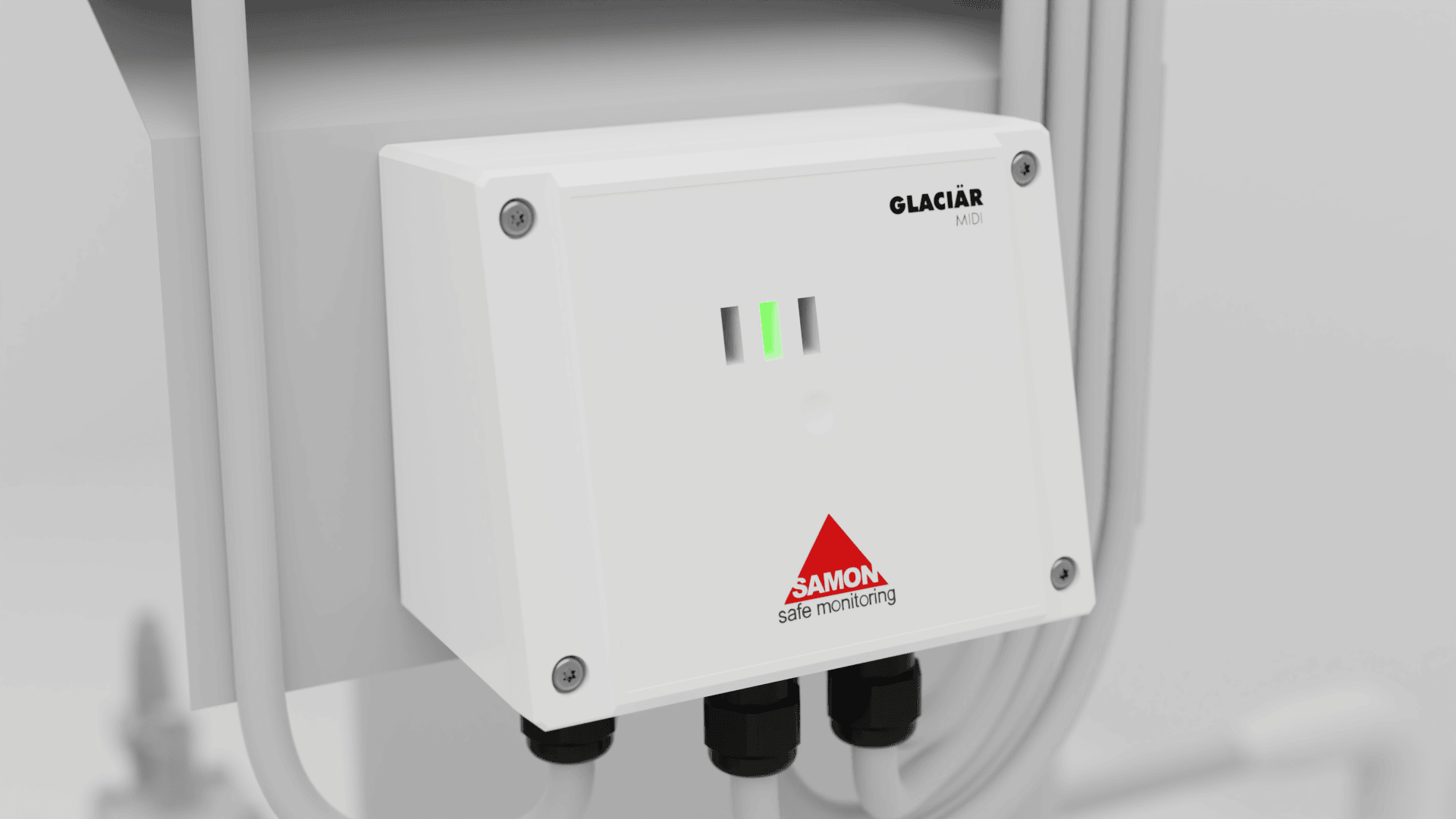
The GLACIÄR MIDI Refrigerant Gas Detector from SAMON is one example of equipment developed with more than 30 years of focused experience in refrigerant gas detection. It is intended for the locations where leaks are most consequential: machinery rooms, cold rooms, food retail and storage, food processing, and other commercial or industrial refrigeration setups.
Rather than requiring a large assortment of specialized sensors, the platform covers the most commonly used refrigerants with a limited set of sensor types. Broadband sensors handle the majority of HFC and HFO blends, an infrared sensor covers CO₂, electrochemical sensors address ammonia across multiple ranges, and a dedicated sensor covers R290 and related hydrocarbons. Both integrated and remote sensor versions are available, giving flexibility in how the sensing point is placed relative to the electronics.
Built for the Conditions
The polycarbonate enclosure is IP67-rated and operates across a wide temperature range (–40 °C to +50 °C on standard variants). Multiple cable glands and pluggable terminals simplify on-site wiring, and units ship with a standard configuration so they can be installed without extensive setup. High-intensity status LEDs provide an immediate visual check, while dual alarm relays, an optional dedicated fault relay, Modbus RTU, and a selectable analogue output support integration into existing refrigeration controls or building management systems.
Maintenance That Matches How Teams Work
Service is designed to stay practical. Built-in counters track service intervals and sensor life. Pre-calibrated replacement modules reduce downtime during swaps. Configuration and calibration can be handled through a smartphone app over Bluetooth (Android and iOS), with a traditional service wheel and magnetic switch available as a tool-free alternative. The goal is that technicians can support the detectors without specialized equipment or lengthy training.
The Broader Context
Technology like this fits into a larger refrigerant management picture that includes accurate charge tracking, timely repairs, and the ongoing transition away from higher-GWP gases. Reliable detection does not replace good system design or regular maintenance, but it closes the gap between a leak starting and someone knowing about it. That gap is where both emissions and unnecessary operating costs accumulate.
For facility managers, contractors, and equipment owners evaluating detection options, the practical questions are consistent: Does it cover the refrigerants on site? Will it hold up in the environment? Can the team install and maintain it without friction? Platforms that answer those points cleanly reduce the barriers to actually using detection effectively.
Contact us today for more information about the GLACIÄR MIDI Refrigerant Gas Detector.
Contact: info@alpynestrategy.com | (615) 323-3126